
Construction Outlook
Mix-Independent Concrete Sensors: Complete Guide to Self-Calibrating Strength Monitoring and SmartRock® Pro
Concrete strength testing has long relied on cylinders, cubes, and laboratory break results to confirm when critical decisions can be made. While this approach remains essential for acceptance testing, it often creates delays in day-to-day construction sequencing. As schedules tighten and material variability increases, many teams are rethinking how strength is monitored in the field.
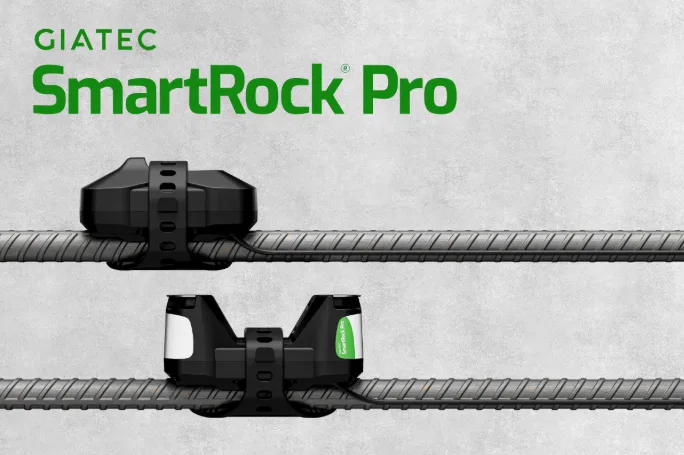
In this article, learn all about mix-independent concrete sensors, why they are gaining attention across the industry, and how self-calibrating technology, such as SmartRock Pro, estimates in-place strength without requiring a mix-specific calibration curve, helping teams make strength-based decisions faster and with more confidence.
Why Mix-Independent Sensors Now?
Concrete work is still often managed through a “confirm later, decide later” loop. Teams cast cylinders or cubes, transport them, cure them, break them, and then decide whether stripping can begin, reshoring can come down, post-tensioning can proceed, or traffic can be restored.
This workflow is proven for acceptance testing. However, it is often too slow for day-to-day schedule control. On fast-track or high-variability projects, the cost of waiting is measured in idle crews, crane time, traffic closures, and downstream trade delays.
Traditional compressive strength testing is time-consuming and resource-intensive. It requires sampling, curing, and destructive testing at defined ages. Results can also vary due to sampling practices, curing conditions, and operator technique
To improve responsiveness, many teams adopted maturity-based approaches under ASTM C1074. These systems estimate in-place strength using temperature history. However, ASTM C1074 requires establishing a laboratory strength–maturity relationship for each specific mixture and tracking temperature history in the field. When mixes, suppliers, materials, admixtures, or field conditions shift, recalibration becomes a recurring management task.
So, what changes with mix-independent sensors?
A mix-independent, self-calibrating sensor estimates in-place strength without requiring a pre-built, mix-specific calibration curve. It does not require manual mix data entry before a pour. SmartRock Pro is positioned as an example of this approach. It uses Concrete Electro-Mechanical Microstructural Analysis (CEMMA) to measure the concrete’s in-situ response during hydration and calculate strength without a traditional concrete calibration program.
Why Does It Matter at a Business Level?
The value is not simply more data. It is schedule certainty. It is risk control. It is governance. Schedule certainty means knowing exactly when strength targets are met, not discovering it later. Risk control means reducing early-loading decisions made on incomplete information. Governance means having a repeatable, documentable strength-monitoring method that is less sensitive to everyday mix variability.
When strength is known in real time, projects can remove avoidable waiting between strength-critical activities. Consider a high-rise core cycle or a bridge segment program where stripping or stressing depends on reaching a target strength. If confirmation only comes after lab breaks, crews may lose a shift or a full day per cycle.
With real-time concrete calibration, where strength trends continuously within the structure, teams can often make the same decision earlier, with clearer supporting evidence. In favorable conditions, this can translate into potential savings of one to two days per major pour.
An Illustrative Scenario: High-Rise Project Through Seasonal Change
Consider a 30-story residential tower with a repeating 6-day core cycle.
The first ten floors are poured in late summer. Temperatures are stable. The ready-mix supplier maintains consistent proportions. A strength monitoring strategy is implemented early in the project.
As the project progresses into winter, ambient temperatures drop. The supplier adjusts accelerator dosage. Minor water adjustments are made on colder days to maintain workability. A new cement shipment is introduced midway through the schedule.
Individually, none of these changes are unusual. Together, they alter hydration behavior.
Under a traditional maturity-based program, the original strength-maturity curve was developed under initial summer conditions. The team now faces a recurring governance question: does the existing calibration still represent current field performance, or should correlation testing be repeated?
Every time conditions shift, confidence must be reassessed.
Under a mix-independent monitoring approach, sensors embedded in the core track the concrete’s in-place electro-mechanical response as it hydrates. Strength estimation is tied to the material’s actual behavior under current conditions, not to assumptions derived from earlier laboratory calibration.
When accelerator dosage changes or cement source shifts, the system continues to measure structural response directly.
The operational benefit is speed and continuity. The team maintains confidence in strength thresholds even as materials and environmental conditions evolve.
Over a multi-month schedule, that continuity reduces calibration debates, reduces testing friction, and stabilizes decision-making under real construction variability.
What Are Mix-Independent Sensors?
In practice, “concrete calibration” usually refers to one of two models:
- Mix-calibrated (maturity-based) systems: These systems estimate strength using temperature history. However, they require a project-specific correlation between maturity and compressive strength for each mix. ASTM C1074 describes the maturity method and explicitly requires developing a strength–maturity relationship in the lab for the mixture, then recording temperature history in the field. Calibration is a structured process. It often includes casting a minimum of 17 cylinders, selecting multiple break times, computing maturity values, fitting a curve, and validating it on a subsequent pour. Calibration applies to a single mixture design. Changes in materials or mixture properties can invalidate it. In environments where mix variability is unavoidable, this becomes a significant governance consideration.
- Mix-independent systems: Mix-independent systems aim to estimate strength without requiring a separate curve for every mix. Instead, the system derives strength from the concrete’s in-situ behavior during hydration. SmartRock Pro is described as mix-independent and self-calibrating. It measures strength without manual input and without requiring a calibration program before pours. It is also described as a wireless, fully embedded sensor that remains tied to rebar and tracks strength under real curing conditions. It is positioned as more resilient to common variability such as admixture adjustments, raw material changes, and water adjustments during delivery.
Understanding CEMMA
CEMMA can be understood in simple terms. As cement hydrates, the concrete’s microstructure changes. CEMMA measures shifts in electrical and mechanical response as these microstructural changes occur. Those signals are then used to estimate strength development over time.
SmartRock Pro is described as using CEMMA to measure microstructure directly and eliminate the need for manual mix calibration.
Comparison Overview
The key difference lies in the strength model.
| Decision factor | Mix-calibrated sensors (maturity method) | Mix-independent sensors (self-calibrating) |
| Primary strength model | Maturity index derived from temperature history; strength estimated via calibration curve | In-place strength inferred from concrete’s measured electro-mechanical/microstructural response (CEMMA) |
| What inputs are needed | Mix-specific calibration curve (lab); maturity parameters; ensure correct curve assigned | Tag sensor + install; no mix calibration curve required beforehand |
| Sensitivity to mix changes | Higher-mix changes can invalidate/erode calibration accuracy | Designed to adapt to mix variability and last-minute changes (e.g., admixtures, water adjustments) |
| Setup time before first use | Slower when calibration is required; may need days/weeks depending on break schedule | Faster to deploy because pre-calibration is not required |
| Decision factor | Mix-calibrated sensors (maturity method) | Mix-independent sensors (self-calibrating) |
| Typical executive use case | Established QA/QC programs with stable mixes; compliance-aligned strength estimation; predictable calibration governance | High-variability projects, fast-track schedules, multi-supplier environments, or remote jobs where calibration logistics are costly |
What’s the Difference Between SmartRock and SmartRock Pro?
Learn more about what makes SmartRock Pro unique.
What Is Mix-Independent Concrete Calibration?
Traditional concrete calibration means building and maintaining a mix-specific relationship between an indirect signal, usually maturity from temperature history, and actual compressive strength. ASTM C1074 defines this framework clearly.
Mix-independent concrete calibration shifts the burden. Instead of calibrating every mix, the system measures what the concrete is doing in place. Embedded sensing tracks evolving material properties and converts those signals into strength estimates. The calibration is anchored to the material response rather than to pre-entered mix assumptions.
Governance and Risk Implications
Real-time concrete calibration becomes a live decision-making system rather than a retrospective report.
- Schedule decisions can be evidence-led earlier. Strength is monitored continuously rather than discovered at discrete break times.
- Mix variability becomes visible. If truck-to-truck performance shifts, the structure reflects it directly.
- Documentation also improves. Digital logs of temperature and strength estimate support QA/QC records, internal reviews, and dispute readiness. SmartRock Pro data is collected via the SmartRock mobile app and processed through the SmartRock® Web dashboard.
How Real-Time Concrete Calibration Works (with SmartRock Pro)
This section describes the end-to-end workflow as a stepwise operational story.
Before the Pour: Tagging and Context
Sensors are tagged in the SmartRock mobile app and associated with element and pour information. This ensures the data stream is tied to a specific decision context.
During Installation: Placement at the Decision Point
SmartRock Pro consists of a probe and an antenna/transmitter connected by a 50 cm cable. The probe is tied to the rebar and installed at the specific location where strength needs to be monitored, typically at the critical section or the area expected to cure most slowly, with the sensing tip oriented upward toward the concrete surface.
Antenna Positioning
For reliable Bluetooth communication, the antenna must be positioned within approximately 2 inches (5 cm) of the concrete surface. This small detail has large governance implications. Consistent placement reduces data gaps and improves system confidence.
Automatic Activation
The sensor is designed to detect pouring time and activate when it contacts fresh concrete. Once placed, it begins temperature measurement and strength calculation without additional user input.
CEMMA Sensing During Curing
As hydration progresses, CEMMA analyzes electro-mechanical changes in the microstructure. These measurements are converted into strength development trends.
Data Access
Data is transmitted via Bluetooth® to the SmartRock mobile app for on-site review. It can then be processed in the SmartRock Web dashboard for broader visibility and reporting.
How This Differs from Traditional Calibration
Conventional Cylinders/Cubes and Lab Breaks
What it is: Concrete is sampled during placement. Specimens are cast, cured under controlled conditions, and tested in compression at defined ages such as 7, 14, or 28 days. Results are used to confirm whether the mix meets specified strength requirements.
Strengths: This method is widely accepted for code compliance and contractual acceptance. It is recognized in standards and provides a defensible reference point for disputes or claims.
Limitations: However, it is slow. Feedback is delayed until break ages are reached. Specimen curing conditions may not match actual structural curing conditions. These gaps become critical when early-age strength governs schedule decisions.
Maturity-Based Sensors (ASTM C1074)
What it is: Embedded temperature sensors record the concrete’s temperature history. A laboratory-developed strength-maturity relationship is created for a specific mix. Field maturity data is then used to estimate in-place strength based on that calibrated curve.
Strengths: Provides earlier strength estimates than waiting for lab breaks. Works well when mixes are stable and laboratory calibration programs are well managed. Supports structured QA/QC programs with repeatable mixtures.
Limitations: Calibration is mix-specific. Changes in cement source, aggregates, admixtures, or proportions can reduce the accuracy of the curve. Recalibration may be required when variability increases.
Mix-Independent Sensors
What it is: Embedded sensors estimate in-place strength without requiring a pre-built, mix-specific calibration curve. Strength is derived from measured in-situ material behavior rather than from a pre-established maturity relationship.
Strengths: Reduces the operational burden of building and maintaining calibration curves. More resilient to normal mix variability and last-minute mix adjustments. Provides timely strength evidence under real delivery conditions.
Limitations: Does not replace code-required acceptance testing. Requires proper installation and initial validation. Engineering oversight remains necessary, particularly for high-consequence release decisions or extreme mix conditions.
Portfolio Strategy
A practical governance model for many portfolios looks like this:
- Keep cylinders/cubes remain for code and contract acceptance.
- Maturity-based sensors work well where mixes are stable and calibration governance is mature.
- Mix-independent sensors are most valuable where variability, fast-track sequencing, or remote logistics make calibration expensive or slow.
Importantly, SmartRock Pro and SmartRock can coexist in the same ecosystem on the same project, enabling selective deployment by risk and decision criticality.
SmartRock Pro: Features and Design
Hardware Architecture
SmartRock Pro consists of a probe and an antenna/transmitter linked by a 50 cm cable. The antenna must remain near the surface to maintain connectivity.
Key capabilities include:
- Mix-independent strength estimation using CEMMA
- Real-time monitoring via the SmartRock mobile app
- Cloud analytics through SmartRock Web
- Automatic activation at pour time
- Monitoring up to 60 days
- Battery life up to four months
- Integration with Procore and other systems via open API
Get a Closer Look at the SmartRock Pro Installation and Features!
Dive deep into SmartRock Pro’s design and how it integrates into Giatec’s ecosystem.
Frequently Asked Questions
What are the Limitations of “Mix Independent” Sensors?
Mix independence does not mean universal application without oversight. These systems eliminate the need to build and maintain a per-mix strength-maturity calibration curve. Instead, they estimate in-place strength by measuring the concrete’s electro-mechanical and microstructural behavior as hydration progresses.
However, several limitations remain.
First, they do not replace code-required acceptance testing. Cylinders or cubes are still required for contractual compliance, regulatory acceptance, and dispute resolution. Mix-independent sensing supports operational decisions. It does not eliminate formal strength verification protocols.
Second, installation discipline matters. Sensor placement, probe orientation, and antenna positioning near the surface are critical to reliable data collection. Poor installation can compromise confidence in the readings.
Third, governance still requires validation. Before using sensor thresholds to authorize high-consequence actions such as stripping, stressing, or opening to traffic, teams should perform initial correlation against break tests to build internal confidence and define acceptable tolerances.
Finally, mix independence reduces calibration burden, but it does not eliminate quality assurance responsibility. Engineering judgment remains central to decision-making.
Mix independence simplifies operations. It does not remove professional accountability.
For Which Project Types Do Mix-Independent Sensors Deliver the Most Value?
Mix-independent sensors deliver the greatest value where strength directly governs schedule progression.
- They are particularly effective in high-rise construction, where cycle times depend on when cores, slabs, or transfer elements reach stripping or reshoring thresholds. Earlier strength visibility reduces idle time between pours.
- In bridge decks and infrastructure projects, strength often controls when traffic can be restored. Real-time in-place monitoring supports earlier, evidence-based opening decisions. This is especially important when multiple ready-mix suppliers are involved.
- Precast and industrialized construction environments also benefit. These operations rely on tight production cycles. Frequent mix adjustments are common. Removing the need to rebuild calibration curves simplifies quality control and accelerates release decisions.
- Projects with high material variability see additional value. This includes work with multiple suppliers, seasonal shifts in raw materials, and complex admixture programs. In such environments, maintaining maturity calibration accuracy across pours can become operationally burdensome.
By contrast, in highly controlled environments where the same mix is used repeatedly and calibration governance is already mature, traditional maturity systems may remain efficient. The strongest strategic value appears when calibration complexity slows execution, supplier variability is routine, and strength-based release decisions sit on the project’s critical path.
For Which Types of Mixes are Mix-Independent Sensors Validated or Recommended?
Mix-independent systems are designed to manage typical construction variability. This includes moderate changes in water content, admixture adjustments, raw material source shifts, and routine field modifications.
They are well suited for standard structural mixes used in commercial, infrastructure, and precast work where variability occurs within normal operating ranges.
However, extreme mix behaviors require prudent validation. Examples include very high supplementary cementitious material (SCM) replacement levels, self-consolidating concrete with unusual rheology, lightweight aggregate concrete, or mass concrete pours with significant thermal gradients.
In these cases, correlation against break tests is recommended before relying on sensor-driven release decisions. Extreme curing environments or non-standard mixture chemistries may require additional validation or model tuning.
Mix-independent systems reduce recalibration frequency. They should still be introduced within a structured validation framework, especially when mix designs depart significantly from conventional practice.
How Do These Sensors Handle Variability in Aggregates, Cement Brands, Admixtures, and Seasonal Changes in Materials?
Traditional maturity systems rely on a fixed strength–maturity curve. That curve assumes a stable relationship between temperature history and strength development. When cement brands change, aggregate sources shift, or admixture dosages are modified, that relationship may no longer hold. Recalibration may be required.
Mix-independent sensors approach strength estimation differently. Instead of relying solely on temperature history, they measure in-situ electro-mechanical and microstructural development during hydration. Strength estimation is derived from the material’s actual behavior inside the structure.
Because the model responds to measured material response rather than to a pre-established temperature curve, it is less sensitive to normal truck-to-truck variability, moderate water adjustments, admixture changes, or seasonal material shifts.
However, reduced sensitivity does not mean immunity. Large material shifts, new binder chemistries, or major formulation changes still require engineering review and validation.
Mix independence improves robustness under variability. It does not replace engineering oversight.
What is the ROI and Payback Period?
Return on investment is typically driven by three primary factors: schedule acceleration, risk reduction, and operational efficiency.
Schedule acceleration occurs when strength-based decisions such as stripping, stressing, lifting, or opening can be made earlier with confidence. Even a single day saved on a repeating cycle can compound across multiple pours.
Risk reduction occurs when early-loading decisions are supported by continuous in-place strength evidence rather than by assumptions or delayed break results. Avoiding even one premature loading event can prevent significant cost and reputational impact.
Operational efficiency improves when calibration logistics are reduced. Fewer rush breaks, fewer recalibration cycles, and fewer administrative corrections lower indirect project costs.
Trade coverage frames the value in terms of reduced delays, reduced waste from break tests, and potential multi-day-per-pour savings in certain contexts. On projects where each day of delay carries significant financial impact, payback can occur within a small number of strength-critical pours.
ROI depends on project scale, schedule pressure, and variability exposure. The higher the schedule sensitivity, the faster the payback.
Explore the Power of Self-Calibrating Concrete Strength Monitoring!
Check out our webinar on SmartRock Pro from our Giatec Expert.